
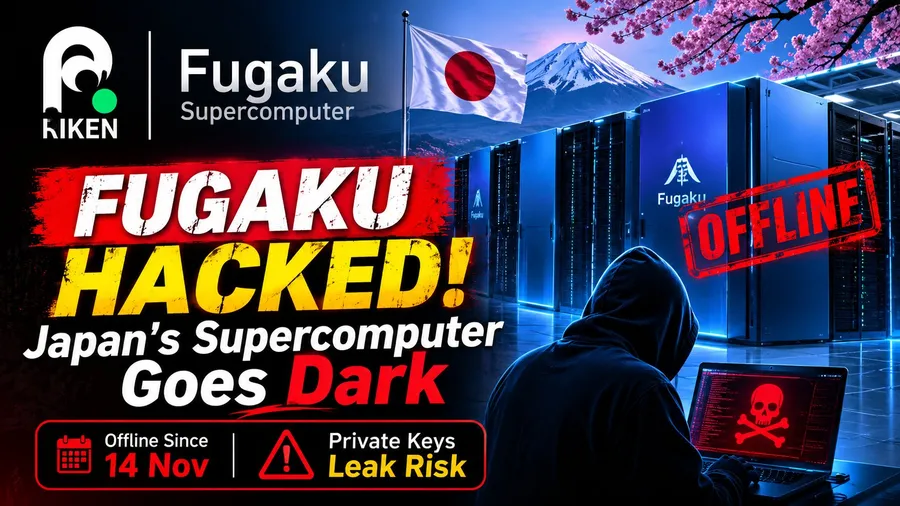
On Monday 16 November 2026, RIKEN — Japan's state research institute — confirmed that an outsider gained unauthorized access to the system used to manage and operate Fugaku, its supercomputer in Kobe. Fugaku's operations are suspended. The machine is offline, with no restart date, and RIKEN is still investigating what the intruder reached.
The short version
- On Thursday 12 November, suspicious external traffic was found on Fugaku's user authentication system
- On Friday 13 November, RIKEN reported the incident to the Ministry of Education, Culture, Sports, Science and Technology (MEXT) as an information-security case
- On Saturday 14 November at 4:30 a.m., RIKEN blocked external access and suspended Fugaku's operations
- On Monday 16 November, RIKEN confirmed the unauthorized access publicly. MEXT has asked it to clarify the facts, assess the damage and bring the supercomputer back online as soon as possible
- Who did it, how they got in, how many accounts were touched and whether any data leaked are still under investigation. There is no restart date
What RIKEN has confirmed
What is confirmed is narrow — and worth stating precisely. RIKEN has confirmed that an outsider gained unauthorized access to the system used to manage and operate Fugaku, the system users connect to in order to use the supercomputer. It has confirmed the timeline: suspicious traffic on 12 November, the report to MEXT on 13 November, external access blocked and operations suspended on 14 November at 4:30 a.m. And it has confirmed that it is still investigating the timing of the unauthorized access, how it was detected, the extent of the damage and whether any data leaked.
What is not confirmed is everything else. RIKEN has not said who the intruder was, how they got in, or how many accounts were touched. The ministry has said the scope of any leak depends on how much personal information each user had stored on the system. The two bodies have also said user data may have leaked — "possibly", not "certainly". That distinction matters, and this post keeps it.
The email: what is still unconfirmed
Alongside the confirmed facts, a second story is circulating — an email to Fugaku users, which has been circulating on X since 15 November. According to reports of that email, files stored in users' home directories were read, private keys and authentication credentials may have been taken, and it cannot be ruled out that all users are affected.
Those three claims are unconfirmed. RIKEN has confirmed that it sent the email, but it says the claims in it are under verification. Until RIKEN confirms them, they are reports — not facts — and this post will not present them as facts. That includes the private keys: nobody knows yet whether any keys were actually taken.
The distinction is not pedantry. A file that was read is damage already done. A private key that was taken is damage that keeps going — and the two claims demand very different responses. Reporting them as established fact before RIKEN verifies them would be exactly the kind of error this blog exists to avoid.
Why the login system was the target
The most important technical detail in this incident is which system was hit. The attackers did not break into Fugaku's compute nodes. They got into the system that manages and operates the machine — the user authentication system, the front door every researcher uses to reach the supercomputer. The 442 PFLOPS of compute power is irrelevant to the attack. The door was the login system.
That is a pattern worth understanding. An authentication system is the crown jewel of any large platform, because it is where trust is decided. It holds the accounts, the credentials and the keys that say who is allowed in. Break the lock, and you do not need to break anything else — the system itself will let you operate as a legitimate user. Fugaku's users include universities and research institutions, and private corporations including pharmaceutical companies and carmakers that use the machine for research such as aerodynamics. Whatever data those users stored on the affected system, the authentication layer was the way to reach it.
Fugaku itself is a national-scale machine. It was jointly developed by RIKEN and Fujitsu, entered full-scale operations in March 2021, and was once the world's fastest supercomputer, in 2020. It runs at 442 PFLOPS with 7.6 million cores, and cost about ¥130 billion — roughly $814 million. None of that power protects a login page. The strongest computer in the world is only as secure as the system that decides who may use it.
Why stolen keys are worse than stolen passwords
If the unconfirmed reports turn out to be true, the private keys are the serious part. A stolen password can be reset; the account holder changes it and the stolen copy becomes useless. A stolen private key keeps working until it is revoked. Whoever holds it can pass as the user on any machine that recognises the key — even far from Fugaku — until the key is revoked and replaced.
That is why the verification matters so much, and why Fugaku users should be ready for rotation. If RIKEN confirms that keys were taken, every affected key must be revoked and reissued, and every system that trusted those keys must be checked. A key is not a password: you cannot change it by typing a new one into a settings page. It has to be retired everywhere it was trusted.
What users and defenders should do now
- Fugaku users: follow RIKEN's instructions and be ready to rotate credentials and keys. If RIKEN confirms keys were taken, revoke and reissue them — do not wait for evidence of misuse.
- Watch for RIKEN's updates, not rumours. The email claims are under verification. The confirmed source of truth is RIKEN and MEXT.
- Defenders: treat your authentication system as your highest-value target. It is the system attackers want most, because it hands them legitimate access. Segment it, harden it, and monitor it separately from the systems it guards.
- Alert on authentication anomalies. Suspicious external traffic on the login system was the first signal at Fugaku, on 12 November — two days before the machine was shut down. The faster an anomaly on the auth layer is noticed, the smaller the incident.
- Have a key-revocation plan before you need one. Know which keys exist, where they are trusted, and how fast you can retire them. Revocation is the part of key management that gets tested only during a breach.
Where things stand
Fugaku has been offline since 14 November, with no restart date. RIKEN is investigating the entry point, the intruder, the accounts touched and whether data leaked. The claims in the user email — files read, keys and credentials taken, all users possibly affected — remain under verification. MEXT has asked RIKEN to establish the facts, assess the damage and restore service as soon as possible. Until RIKEN says more, the honest summary is short: the login system was breached, the machine is dark, and the most serious claims are still unconfirmed.
Sources
- NHK World, "Japan's supercomputer suffers unauthorized access" — nhk.or.jp
- Kyodo News, "Japan's Fugaku supercomputer hit by unauthorized access, data leak feared" — english.kyodonews.net